
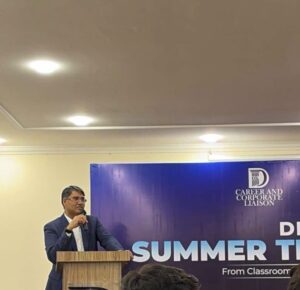
Multan: Barrister Taimur Malik, Senior Partner at Kilam Law and founder of Courting The Law, delivered a two-hour masterclass at Denning Law School, Multan, before an audience of approximately ninety law students and recent graduates. The session, titled “Building an International Legal Career: From Multan to the World,” paired a formal lecture with an interactive discussion on the evolving contours of the global legal profession and the deliberate steps young lawyers must take to build careers of genuine international standing.
Redefining the International Career
Rather than presenting a conventional motivational talk, Malik urged participants to approach career development with strategic discipline. He challenged the prevailing assumption that an international legal career is defined by physical relocation abroad, contending instead that it is increasingly defined by the capacity to resolve complex cross-border legal and commercial problems, irrespective of where a lawyer is based.
A Career Forged Across Four Jurisdictions
Drawing on more than two decades of practice spanning Pakistan, the United Kingdom, the United Arab Emirates and Oman, Malik traced the arc of his own career: from his studies at Lincoln’s Inn and early work in public international law, through advisory roles serving multinational corporations, international organisations and governments, to his eventual return to Pakistan to found Kilam Law, Courting The Law and Qanoondan.
A central thread running through the masterclass was the conviction that international careers are seldom the product of chance. Rather, they are cultivated deliberately, over many years, through sustained investment in knowledge, writing, professional relationships and reputation. Malik added that a lawyer’s success ought ultimately to be measured not merely by personal achievement, but by the opportunities created for others along the way.
Technology as Opportunity, Not Threat
Addressing the future trajectory of the profession, Malik reflected on the transformative influence of artificial intelligence and legal technology. He encouraged students to embrace this change rather than resist it, observing that the legal profession is unlikely to be supplanted by artificial intelligence so much as reshaped by it, to the particular advantage of those who learn to integrate such tools skilfully into their practice.
Where the Opportunities Lie
The masterclass surveyed a broad spectrum of emerging practice areas for students to consider, among them:
- International arbitration and cross-border transactions
- Technology law and legal technology
- Public international law
- Venture capital
- Humanitarian law
- Insurance and reinsurance
- Regulatory practice
- Academia and public policy
- International organisations
Malik further exhorted students to cultivate commercial awareness beyond technical legal proficiency, encouraging the study of economics, finance, business, geopolitics and technology, on the premise that today’s lawyers are increasingly called upon to serve as strategic advisers rather than mere legal technicians.
Practical Counsel from the Floor
The discussion that followed ranged across a wide array of practical concerns, including:
- Internships and pupillage
- Postgraduate study abroad
- Careers in the Gulf region
- Networking and the cultivation of professional reputation
- Publishing legal scholarship
- Entrepreneurship
- Opportunities arising from legal technology
Students also considered the importance of adaptability in an increasingly fluid profession, alongside the merit of cultivating deep expertise within a specialist practice area while retaining a broader, global outlook.
The masterclass forms part of Denning Law School’s continuing efforts to expose its students to seasoned practitioners of diverse legal backgrounds and to foster considered discussion on the future of legal education and practice. As the legal profession grows ever more interconnected across borders, engagements of this nature furnish students with a practical sense of the skills, disposition and professional habits required to compete within an increasingly globalised legal marketplace.

Thanks for putting this together! Extremely well structured.