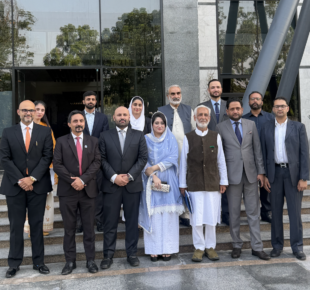
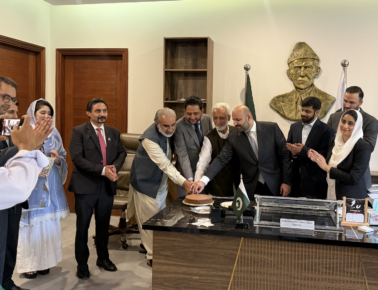
The Climate Change Committee of the Islamabad High Court Bar Association organized a seminar on “Climate Change and its Mitigation in the Age of AI” at the Islamabad High Court Bar Association on Friday, 7 August 2026.
The seminar brought together members of the legal fraternity, law students, climate change as well as environmental experts and other stakeholders to discuss the evolving challenges posed by climate change and the opportunities presented by emerging technologies to reduce its mitigation.
Advocate Hassan Khan opened the proceedings by welcoming the distinguished panelists and set out the context for the discussions that followed. Zain Ali, Chair of the Committee, welcomed the distinguished panelists and participants. He gave an overview of the Committee’s purpose of holding the seminar. Which was, to equip and enhance the climate literacy amongst the legal fraternity. Barrister Sara Kazmi outlined the future goals of the Committee, which were a climate change law blog and a dedicated climate change law directory for Islamabad climate change lawyers. The blog is intended to highlight climate-related jurisprudence, especially judgments from the Islamabad High Court, and to invite lawyers and law students to contribute short case notes on decisions involving climate change, environmental law, and sustainability. This was followed by Advocate Adam Jabbar gave a detailed overview of the nexus between artificial intelligence and climate change, stressing on how it can be used in tackling /addressing climate change in a more efficient and less impactful manner.
The first panel, titled “The Evolving Landscape of Climate and Environmental Law”, was moderated by Barrister Faiza Asad, Co-Chairperson of the Climate Change Committee, and featured Syed Hassan Ali Raza, Advocate Supreme Court of Pakistan; Zainab Naeem, Environmental Scientist and Climate Risk Expert; and Asjadullah Qureshi, Climate and Clean Energy Expert.
The session examined Pakistan’s existing climate and environmental legal and regulatory frameworks and considered whether they are sufficiently equipped to address emerging environmental challenges. The discussion also explored the practical measures required to accelerate Pakistan’s transition towards cleaner and renewable energy, with particular emphasis on structural barriers including regulatory uncertainty, institutional fragmentation and implementation gaps.
The panel observed that, while Pakistan has developed a relatively comprehensive legal and policy framework for environmental protection and climate action, its effectiveness continues to be constrained by inconsistent enforcement and institutional capacity. The speakers emphasized the need for stronger coordination between federal and provincial institutions, clearer delineation of responsibilities and accountability, and effective implementing mechanisms to ensure that climate legislation translates into meaningful action. The discussion further considered the potential of artificial intelligence and satellite technologies to strengthen climate modelling, forecasting and disaster early-warning systems, particularly in relation to flood prediction, water-resource management and urban resilience.
During the session, Barrister Faiza asked the panelists to examine the role of the judiciary, regulators and policymakers in advancing sustainable development, alongside the importance of sustainable urban planning, public participation and constitutional protections, including the recognition of environmental rights under Article 9A of the Constitution of Pakistan. The discussion highlighted the increasing relevance of climate considerations in judicial and regulatory decision-making and the need for environmental concerns to be integrated into broader governance and development frameworks.
The second panel was moderated by Advocate Musa Khan Amanullah, Member of the Climate Committee, titled as ‘Governance, Law and International Cooperation’ and featured Justice (Retired) Mushir Alam, former Judge of the Supreme Court of Pakistan; Dr Muhammad Khurshid, former Director General of the Pakistan Environmental Protection Agency (Pak-EPA) and SACEP; and Aftab Muhammad Khan, Secretary General, Pakistan National Commission for UNESCO. The session provided further insights into Pakistan’s energy planning, the development of carbon-market infrastructure, data-driven regulatory analysis, and the important intersection between judicial oversight, environmental protection and sustainable development.
In his remarks. Justice (Retired) Mushir Alam appreciated the efforts of the Climate Committee in organizing the seminar and stressed the importance of creating greater awareness and informed discourse on climate change and environmental issues within the legal community. He observed that initiatives of this nature were the need of the hour, particularly given the growing environmental challenges confronting Pakistan and the need for the legal fraternity to play a more active role in addressing them. His remarks provided a strong endorsement of the Committee’s initiative and its efforts to place climate and environmental concerns more prominently on the legal agenda.
In his concluding remarks, Zain Ali, Chair of the Climate Change Committee, thanked the Islamabad High Court Bar Association for its support in facilitating the initiative and reiterated the Committee’s commitment to promoting informed legal and policy discourse on climate and environmental issues. He also announced the Committee’s intention to work towards the publication of a white paper on environmental matters, which would provide a platform for examining key environmental challenges and proposing legal, regulatory and policy reforms. He concluded on a forward-looking note, expressing the Committee’s hope to organize further substantive and impactful programmes on climate change, environmental law and emerging technologies.
