
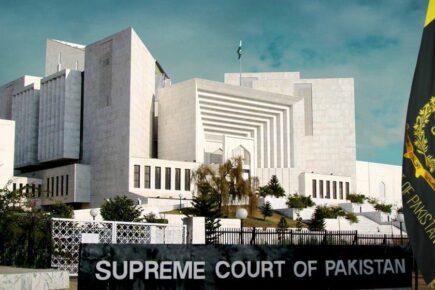
In Arshad alias Billu v. State, the Supreme Court of Pakistan directed all Inspectors General of Police to ensure that no derogatory or discriminatory terms are recorded in FIRs, emphasizing that such language violates fundamental rights and the principles enshrined in the Constitution of Pakistan, 1973. The Full Bench of the Supreme Court, headed by Justice Muhammad Hashim Khan Kakar, held that designations such as “New Muslim” carry no legal or religious validity, affirming that every person who embraces Islam is entitled to equal respect and status as any other Muslim.
The instant jail petition has been instituted by the petitioner-convict, Arshad alias Billu, assailing the judgment dated 29.01.2019 rendered by the Lahore High Court, Lahore, whereby his appeal was dismissed. The High Court maintained his conviction under Section 302(b) of the Pakistan Penal Code; however, the sentence of death awarded by the learned Trial Court was commuted to imprisonment for life. The prosecution case originates from an FIR lodged on the statement of Jahangir, the Prosecution Witness (PW-5), a cultivator and resident of Thathi Hinduan.
The complainant had leased land measuring approximately 2½ acres from Muhammad Akram for Rs. 40,000/- and cultivated a chari crop thereon. After harvest, the land remained vacant. On 23.10.2004 at about 11:30 a.m., the complainant proceeded to his agricultural land and observed that the petitioner, along with co-accused persons armed with 12-bore guns, had irrigated the land using tube-well water. Upon questioning, the accused allegedly grappled with him. Muhammad Tufail and Jaan Muhammad, brothers of the complainant, arrived at the scene.
One co-accused raised a lalkara to seize and kill them. The petitioner allegedly fired a 12-bore gunshot at Muhammad Tufail, striking him on the right thigh, causing him to fall. The other accused also resorted to firing, inflicting multiple injuries on Jaan Muhammad. Upon hue and cry, several persons witnessed the occurrence. The accused fled while making aerial firing. Muhammad Tufail succumbed to his injuries at Kanganpur Hospital, while Jaan Muhammad was referred to Ellahabad Hospital for further treatment. Upon completion of the investigation, the petitioner and his co-accused were sent to trial. The Trial Court convicted the petitioner under Section 302(b) PPC for the murder of Muhammad Tufail and sentenced him to death, in addition to payment of Rs. 200,000/- as compensation to the legal heirs of the deceased, with a default stipulation of six months’ simple imprisonment. The High Court maintained the conviction but modified the sentence to imprisonment for life.
The occurrence took place in broad daylight, and the FIR was promptly lodged, specifically nominating the petitioner and attributing a distinct role to him. The prosecution examined two eyewitnesses: Jahangir (PW-5), the complainant, and Jaan Muhammad (PW-6), an injured witness. Both witnesses furnished plausible explanations for their presence at the scene. Being residents of the locality, their presence was natural. Their ocular account was corroborated by medical evidence, and their statements remained consistent throughout the trial. No material evidence suggested animus or false implication. Both the Trial Court and High Court concluded that the prosecution had established the petitioner’s guilt beyond a reasonable doubt. Learned counsel for the petitioner contended that the prosecution failed to prove its case beyond a reasonable doubt and prayed for acquittal. Conversely, the learned Deputy Prosecutor General submitted that the evidence was reliable, confidence-inspiring, and corroborated, thus warranting dismissal of the petition.
Certain mitigating circumstances emerged from the record. The incident followed a sudden altercation; the petitioner fired a single shot directed at a non-vital part of the body, and no undue advantage was taken. While there was no justification to interfere with the conviction, these factors persuaded the Court to reduce the sentence. Accordingly, the sentence of imprisonment for life was reduced to fifteen years’ rigorous imprisonment. This reflects a developing sentencing jurisprudence that emphasizes proportionality and calibrated punishment based on moral blameworthiness rather than mechanical statutory maxima.
During the proceedings, it was noticed with grave concern that the complainant was described in the FIR as “Nau-Muslim Sheikh.” Such classification is devoid of a legal or religious basis. In Islamic doctrine, once a person embraces Islam, he or she is regarded as fully equal to all other Muslims. Justice Kakar, referred the Farewell Sermon of the Holy Prophet (PBUH) explicitly rejects distinctions of superiority based on lineage, ethnicity, or social origin: “All mankind is from Adam and Eve, an Arab has no superiority over a non-Arab nor a non-Arab has any superiority over an Arab; also a White has no superiority over a Black nor a Black has any superiority over a White except by piety and good action. Learn that every Muslim is a brother to every Muslim and that the Muslims constitute one brotherhood. Nothing shall be legitimate to a Muslim which belongs to a fellow Muslim unless it was given freely and willingly.” Describing someone as a “New Muslim” carries no doctrinal necessity and implies no valid religious distinction.
From a constitutional standpoint, Article 14 guarantees human dignity, Article 25 ensures equality before the law, Article 26 prohibits discrimination based on religion, race, caste, sex, or place of birth, and Article 33 directs the State to discourage parochial and sectarian prejudices. Officially identifying a citizen as “New Muslim” serves no legitimate investigative purpose unless directly relevant to the elements of an offence. Instead, it risks stigmatization and perpetuates social hierarchies that constitutional law seeks to dismantle. In South Asian contexts, descriptors like “Nau-Muslim” often serve as coded references to caste or prior social status. Their inclusion in official records categorizes and differentiates individuals, potentially demeaning them. A society that relies on the labor of marginalized communities while marking them with indicators of inferiority highlights systemic failure rather than individual deficiency.
Recognizing the discriminatory impact, the Court directed all Inspectors General of Police to ensure that no reference to caste, tribe, biradari, or conversion status appears in FIRs, arrest memos, investigation reports, or any police record unless strictly necessary for bona fide investigative reasons recorded in writing. The Court emphasized that equality, dignity, and citizenship are inherent and indivisible, and official records must not perpetuate stigma or social hierarchies. These directions were sent to all concerned authorities for immediate compliance.
The judgment demonstrates a dual exercise of judicial responsibility. In the criminal adjudication, it affirmed the conviction under Section 302(b) PPC with recalibrated sentencing to reflect mitigating circumstances. The Court adhered to principles of appellate restraint, confirming the reliability of eyewitness testimony and medical corroboration. In its constitutional reflection, the Court denounced caste-based or conversion-based identifiers in official records. By invoking Islamic teachings, constitutional guarantees, and international human rights instruments such as the UDHR, ICCPR, and ICESCR, the Court emphasized the universality of equality and the impermissibility of discriminatory classifications.
While some procedural critiques could be made, such as more detailed engagement with inconsistencies or sentencing rationale, the judgment is notable for balancing doctrinal criminal law reasoning with transformative constitutional interpretation. It recognizes that language in official documentation is not neutral but has structural implications and extends protections of dignity and equality from constitutional text to administrative practice.
The “New Muslim” issue is not about conversion itself, but whether the State may classify citizens within the same religion in a manner that risks stigma, discrimination, or erosion of equal citizenship. The judgment clarifies that equality is not conditional, dignity is not graded, and citizenship is not stratified. By coupling measured criminal adjudication with a firm denunciation of discriminatory nomenclature, the Court transformed a routine appeal into a powerful affirmation of constitutional values. The judgment confirms guilt and applies proportionate sentencing in a murder case, declares that descriptors like “New Muslim” are legally, religiously, and constitutionally unjustifiable, and directs systemic reform to eliminate discriminatory identifiers from official records. It embodies a progressive approach, combining criminal law principles with transformative constitutional interpretation to uphold human dignity, equality, and citizenship rights.
It is further affirmed that Islamic pedagogy places significant emphasis on extending comprehensive support, compassion, and encouragement to individuals who have newly embraced Islam. The Qur’ān unequivocally enjoins respect for human dignity and the prohibition of mockery and derision among believers, commanding: “O you who believe! Let not a people ridicule another people; perhaps they may be better than them…”—a clear injunction against belittling any person, which by extension includes newly converted Muslims. Additionally, the Qur’ān repeatedly emphasizes the equal worth of all humans before God, affirming that no distinction of lineage, ethnicity, or status should be used to demean another (“O mankind! Indeed We have created you from a male and a female… most noble in the sight of Allah is the most righteous of you.”).
Prophetic tradition reinforces this ethical framework by underscoring that a true believer is one whose words and actions bring no harm to others, whether by hand or by tongue. The Prophet ﷺ also taught that kindness and mercy are among the highest virtues, instructing that those who show mercy to others will, in turn, be shown mercy by God. Consequently, any conduct—verbal or social—that ridicules, ostracizes, or diminishes a person contradicts the ethical and moral foundations of Islam, undermining its universal message of dignity, justice, and humane treatment of all individuals, regardless of their background.
In conclusion, this judgment transcends the ordinary scope of a criminal appeal. While it meticulously affirms guilt and calibrates punishment to the moral culpability of the offender, its most enduring impact lies in its resolute defense of human dignity and equality. By unequivocally rejecting the use of discriminatory terms such as “New Muslim” in official records, the Court asserts that the State cannot classify or stigmatize citizens within the same faith. The decision harmonizes Islamic principles, constitutional guarantees, and international human rights norms, affirming that no individual may be diminished on account of origin, conversion, or social background. It demonstrates that justice is not merely a mechanical exercise of penal codes but a holistic commitment to fairness, proportionality, and respect for the inherent worth of every person. Ultimately, the judgment transforms a routine legal dispute into a landmark affirmation that equality, dignity, and citizenship are inalienable, indivisible, and beyond the reach of social hierarchies, setting a powerful precedent for both criminal jurisprudence and the broader project of social justice in Pakistan.


