
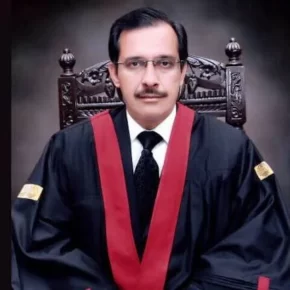
A tribute to Justice (R) Shahid Karim, who silently retired on 19 August 2026 from the Lahore High Court. Karim J son of Fazal Karim J dominated Pakistan’s constitutional, civil and commercial facets with thousand of unreported judgments and hundreds of landmark, reported judgments, each more remarkable than the previous. In his respite, Pakistan’s Supreme Judiciary has lost a Jurist.
Syed Hassan Ali Raza, ASC
There is a peculiar discomfort in Pakistan’s recurring constitutional crises as we personalise institutional change. We ask which judge has been transferred, which Chief Justice has been appointed, which judge has resigned, which bench has been constituted, or which particular judge has been elevated. The personalities change; the headlines change; and the political alignments change. Yet beneath these episodic controversies lies a much more consequential story.
Nothing, perhaps, has happened to judges. A great deal, however, has happened to the judiciary.
The transformation is best understood not through the fate of individual judges, but through the gradual relocation of the power to constitute, organise, elevate and, increasingly, move judges. What began as an intensely judicialised appointment system has travelled through institutionalisation, parliamentary participation, constitutional engineering and, ultimately, the creation of an entirely new judicial architecture. The story is not merely about who appoints a judge. It is about who possesses the power to shape the institution within which that judge must decide.
Pakistan’s constitutional journey began with executive appointment of judges after consultation, but Al-Jehad Trust v. Federation of Pakistan (PLD 1996 SC 324) transformed “consultation” into a substantive judicial safeguard by giving decisive weight to the views of the Chief Justice of Pakistan and the concerned High Court. Although the Chief Justice did not technically possess unilateral appointment powers, the system effectively placed him at the centre of judicial appointments, creating what may retrospectively be described as a one-man-consent model, a system of judicial predominance rather than executive control.
The arrangement carried an obvious vulnerability: judicial independence is not synonymous with judicial self-replication. The 18th Amendment therefore replaced the Chief Justice’s predominance with the institutional framework of the Judicial Commission of Pakistan, bringing the judiciary, executive, Parliament and legal fraternity into the appointment process. The Nineteenth Amendment subsequently restored greater judicial influence. What appeared to be a constitutional compromise, however, also introduced a new reality: power was no longer concentrated in one institution, but neither was it necessarily neutral as it became negotiated power.
The 26th Amendment marked another decisive shift: it ended the automatic elevation of the senior-most Supreme Court judge as Chief Justice, instead providing for selection from the three senior-most judges by a twelve-member Special Parliamentary Committee (eight from the National Assembly and four from the Senate) with formal appointment through the Prime Minister and President. While seniority was no guarantee of wisdom or competence, it provided predictability and insulation from career considerations; the new system replaced that certainty with discretion, creating the possibility (and perception) of influence over judicial careers. The Amendment also increased parliamentary representation in the Judicial Commission, previously more heavily weighted towards the judiciary, which subsequently adopted formal criteria for evaluating judicial candidates. The judiciary had thus moved substantially from an era of Chief Justice-centred judicial predominance to a more dispersed, negotiated and politically exposed appointment structure.
But then came the 27th Amendment. If the 26th redistributed the levers of judicial power, the 27th changed the machinery itself by creating the Federal Constitutional Court (FCC), dividing Pakistan’s judicial structure between the Supreme Court and a new court vested with core constitutional jurisdiction. The FCC was given its own Chief Justice and judges, with its first Chief Justice appointed by the President on the Prime Minister’s advice from among Supreme Court judges, and its first judges appointed on the Prime Minister’s advice in consultation with the FCC Chief Justice; thereafter, appointments move through the reconstituted Judicial Commission and parliamentary mechanism. The journey from judicial primacy had thus reached a new destination, where executive and parliament exercises substantially greater influence over the composition and leadership of the superior judiciary. The concern is not that every such appointment will be improper, but the structural question is who appoints those who may ultimately determine whether the appointing government has acted constitutionally?
The same concern becomes sharper with transfers. Previously, Article 200 required a High Court judge’s consent, alongside consultation with the relevant Chief Justices; the 27th Amendment removed that consent, allowing transfer on the Judicial Commission’s recommendation, with refusal potentially triggering Article 209 proceedings and suspension of judicial functions. Transfer, therefore, is no longer merely administrative. It is “involuntary” and may affect institutional survival. Islamabad is particularly instructive: as the federal High Court, its judges routinely confront the executive and political establishment, making its composition constitutionally consequential. The transfer of judges into the IHC in 2025, subsequent controversy over the mechanism, and the movement of three IHC judges to other High Courts in 2026 demonstrate why transfers cannot be dismissed as routine administration. Some say the transferred IHC Judge’s scummed, other say they wait, and most say they moved on. I think not and I know not but that the institutional consequence remains: judicial independence requires not merely honest judges, but a court whose composition, continuity, jurisdiction and internal hierarchy are insulated.
Remove particular judges and the institutional culture changes. Introduce new judges and the institutional culture changes. Alter seniority and the institutional culture changes. Change who appoints the Chief Justice and the institutional culture changes. Change which court hears constitutional litigation and the institutional culture changes. Give the state a stronger mechanism to transfer judges without their consent and the institutional culture changes. None of these acts, standing alone, necessarily affect judicial independence. Together, they can transform it.
This is why the title of the present moment should not be “What has happened to the judges?” The more important question is: What has happened to the judiciary? The answer is uncomfortable because it does not depend upon whether Judge A is courageous or Judge B is compliant. Institutions are larger than their incumbents. A brave judge operating within a dependent institutional architecture remains individually brave; the institution itself may nevertheless be vulnerable.
Pakistan’s constitutional history has therefore moved through four broad stages. First, there was executive appointment restrained by judicial interpretation. Second, there was judicial predominance crystallised through the Chief Justice’s primacy. Third, there was institutionalisation through the Judicial Commission, followed by parliamentary participation. And fourth, now there is constitutional restructuring through parliamentary and executive participation, a new Federal Constitutional Court, a transformed appointment mechanism and a significantly altered transfer regime. Seen in isolation, each stage can be defended as reform. Seen cumulatively, the direction becomes much harder to ignore.
The danger is not necessarily that tomorrow every judge will become beholden to the government. Constitutional decay rarely announces itself so dramatically. The subtler danger is that judges begin to understand that the architecture surrounding their office has changed; that elevation is discretionary, institutional leadership is selectable, constitutional jurisdiction has moved, and even geographical continuity of judicial office is no longer protected by consent. That is how independence can erode without a single judge being removed.
The irony is almost Shakespearean: the judge remains seated, robed and constitutionally protected, while the institution around him is rearranged.
And perhaps the ultimate test of the present constitutional moment is not whether the courts can still produce independent judgments. They can, and undoubtedly will. The real test is whether the constitutional architecture gives the next generation of judges sufficient reason to believe that they may do so without calculating the institutional consequences. That is the true meaning of judicial independence.
Nothing has happened to judges. A lot has happened to the judiciary. So Help them God to preserve the Constitution.
