
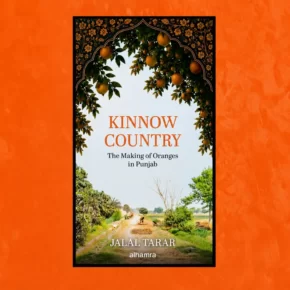
Tarar, Muhammad Jalal Yousaf. Kinnow Country: The Making of Oranges in Punjab. 300pp. Alhamra 2026.
What, exactly, is a tree in law?
The question sounds almost facetious. A tree is a tree. Yet place one at the centre of a legal dispute and the answer becomes surprisingly elusive. A fruit tree may be treated as property distinct from the soil in which it stands; an improvement enhancing the value of that soil; a separately compensable asset when the state acquires the land; or, when agricultural land is partitioned between heirs, an inseparable feature of the holding itself. The same tree can acquire a different legal personality depending upon the question being asked.
This curious problem appears midway through Jalal Tarar’s Kinnow Country: The Making of Oranges in Punjab, a history of Punjab’s most recognisable citrus fruit. In Karnail Singh v State of Punjab, discussed in the book, the number of guava trees standing on acquired land became important enough for the parties to dispute whether there were 150 or 400 of them. The Court treated the trees as separately compensable units. Tarar places this alongside Pakistani acquisition proceedings in which compensation has similarly been calculated separately for land, crops and trees. Inheritance produces another answer. Under the West Pakistan Land Revenue Act 1967, an orchard being partitioned is divided according to the agricultural holding. Its trees remain embedded within the land rather than becoming individual units to be counted and distributed among the heirs.
The same kinnow tree, then, can be a crop, property, an improvement to land, a separately compensable asset, or an inseparable feature of an agricultural holding depending upon the legal question being asked.
This is among the more unexpected pleasures of Kinnow Country. The book is principally a history of a fruit and the region that came to grow it. Its encounters with law arise organically from that inquiry. They demonstrate how difficult it is to write the history of something as ordinary as an orange without eventually encountering law.
What does an orange have to do with law? Quite a lot, as it turns out.
For an orchard to exist, someone must possess the land beneath it and enjoy access to the water that sustains it. Someone must be willing to plant trees that will occupy that land for years before yielding their full return. When the owner dies, rules of inheritance shape the orchard’s future. When the state acquires it, rules of compensation determine what the trees are worth. When thieves enter at night and strip its branches, the fruit becomes the object of an offence against property. And when a kinnow finally leaves Punjab, it enters another legal and regulatory world of inspections, certificates, standards and borders.
Tarar’s subject is therefore deceptively simple. Every winter, central Punjab fills with kinnow: in orchards and mandis, at roadside stalls and dining tables, aboard trucks bound for Karachi and ships bound for foreign ports. Its ubiquity lends it an air of permanence. Yet the citrus landscape surrounding Sargodha is far younger than it appears. Kinnow Country asks how it came into existence.
The answer carries the reader far beyond Sargodha. Citrus travels through Asian gardens and imperial courts, Mediterranean orchards and the industrial citrus landscapes of California and Florida. Horticultural experimentation eventually produces the kinnow, which crosses continents before finding an extraordinarily congenial home in central Punjab. The book describes itself as both a history of a fruit and a portrait of a region, and its most rewarding passages often arise where those two histories become indistinguishable.
For the legal reader, the making of that region holds particular interest.
Long before central Punjab became kinnow country, it became canal-colony country. British irrigation projects transformed vast tracts of the Punjab countryside. Engineering supplied the canals; law supplied much of the architecture through which the landscape could be reordered. Land was surveyed, classified, allotted and recorded. Settlers were selected. Water was apportioned. Rights and obligations became attached to holdings. Administrative categories translated a fluid countryside into chaks, boundaries, tenures and registers.
Even the word “waste” carried power. Land described by the colonial state as uncultivated waste could be brought within a new regime of ownership and settlement. Such classifications converted a landscape into something administratively legible and legally disposable. The question of who used that land, how they used it, and whether their use resembled the settled agriculture favoured by the colonial state became deeply consequential.
The pastoral communities of the region experienced that consequence acutely. Kinnow Country places canal colonisation alongside the colonial state’s efforts to sedentarise mobile populations and its use of legislation such as the Criminal Tribes Act 1871. Behind the apparently technical language of settlement lay a profound exercise of authority: the power to determine what land was for, who could occupy it, and which ways of living upon it would receive legal recognition.
The Punjab Land Alienation Act 1900 supplied another piece of this agrarian order. By restricting transfers of agricultural land outside officially recognised agricultural groups, it helped shape the social distribution of landed property. Its afterlife provides one of the book’s stranger encounters between the colonial past and contemporary Pakistani law. The statute survives in the Punjab Code more than a century later. Its original caste-based architecture has largely lost legal force, while provisions such as section 16 continue to surface in litigation concerning the execution of decrees against agricultural land.
The history of the kinnow thus leads into a larger proposition: law participated in making the agricultural Punjab in which the fruit would eventually flourish.
That proposition becomes especially significant once trees enter the landscape. Orchards impose an unusual relationship with time. Wheat allows the cultivator to sow and reap within a season. A young citrus tree asks for years. Land must be committed, water supplied, labour expended and capital absorbed while the anticipated return remains somewhere in the future. Secure possession acquires a practical meaning measured in growing seasons. The decision to plant an orchard therefore rests upon an institutional world capable of sustaining investment across time.
Once established, the orchard develops legal complications of its own. Trees vary in age, health and productivity. Irrigation channels cross boundaries that may later divide separate shares. A partition on paper encounters roots, watercourses and rows of trees on the ground. The book’s discussion of inheritance is particularly effective here because an abstract legal problem becomes almost tactile: where does one person’s orchard end and another’s begin when the trees and the irrigation system were planted as a single living unit?
Property also has to be defended.
Tarar reaches back to Feroze Khan Noon, writing in 1958, for a wonderfully earthy explanation of why growers sold their fruit to contractors. Orchard owners, Noon observed, could scarcely guard their trees day and night as contractors did. Thieves sometimes arrived before the fruit had ripened and stripped entire branches bare. “In the countryside,” he concluded, “theft is a great curse.”
The anecdote brings the legal abstraction of property down to its simplest physical reality. Ownership of fruit means little when someone can carry it away during the night. An orchard requires watching as well as watering. The contractor therefore assumes a role that extends beyond buying and harvesting: he guards an asset whose value remains exposed on thousands of branches across acres of open land. The history of property here becomes a history of possession in its most literal sense.
This movement between the enormous and the intimate gives Kinnow Country much of its character. Colonial settlement law appears alongside a stolen orange; irrigation regimes alongside a watercourse running between inherited shares; international trade alongside the scratches on a piece of fruit. The book repeatedly moves from systems to objects, then allows the object to illuminate the system.
The same method follows the kinnow after harvest.
An orange intended for export undergoes a remarkable change in status. At a processing plant, fruit is washed, waxed, graded and measured against standards governing size, colour, shape and condition. Export requirements subject it to another layer of scrutiny. The Department of Plant Protection inspects consignments for pests, diseases and quarantine risks and issues phytosanitary certification for compliant shipments. Destination markets may impose treatment requirements, while private certification regimes introduce further standards concerning production and handling.
By the time a carton of kinnow reaches a refrigerated container, the fruit has acquired what might be called a documentary shadow. Lot codes and treatment records accompany container and seal numbers, phytosanitary certificates, certificates of origin, packing lists, invoices and shipping documents.
The orange hanging silently from a tree in Sargodha has become a documented commodity capable of crossing an international border.
The scale of Tarar’s undertaking occasionally leaves the reader wishing to linger longer in some of the worlds through which the book passes. Citrus travels across centuries and continents here, and the narrative ranges through botany, empire, agricultural science, political economy, literature, law and everyday life. Certain episodes inevitably pass more quickly than their richness might warrant. Yet this breadth also supplies the book with its distinctive method. The orange becomes a thread capable of drawing seemingly remote histories into the same frame.
For lawyers, that method has a particular appeal. Legal education trains the eye towards statutes, judgments, constitutions and institutions. Kinnow Country directs it towards the material world those things govern. Law appears in the canal outlet through which water reaches a field; in the revenue entry recording ownership; in the branches guarded against thieves after dark; in the inherited orchard whose division proves more complicated than the shares written on paper; in the valuation of a tree marked for acquisition; and in the certificates travelling beside a refrigerated container towards a foreign port.
By the end, the question with which the book began to interest the legal reader — what is a tree in law? — has acquired a much larger answer.
Kinnow Country is not principally a book about law. Nor should it be read as one. But that is precisely what makes its legal encounters so revealing. Law emerges here as part of the texture of ordinary life: in who owns the earth beneath a tree, who may draw the water that sustains it, who may take its fruit, what happens to the orchard when its owner dies, how the tree is valued when the state acquires the land, and what documents its fruit must carry before it can cross a border.
The history of an orange turns out, among many other things, to be a history of law.
Book link: https://www.alhamra.com/product/prod_01KZZSYC7TCD56P3TKJDFJ4KD5
