
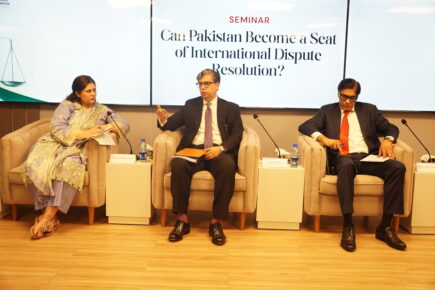
Pakistan has a real chance of becoming a hub for international dispute resolution, but only if it commits to roughly ten years of sustained legal, institutional and professional reform. That was the consensus at a seminar titled “Can Pakistan Become a Seat of International Dispute Resolution?”, hosted by the Islamabad Policy Research Institute (IPRI) in Islamabad on 11 September 2026.
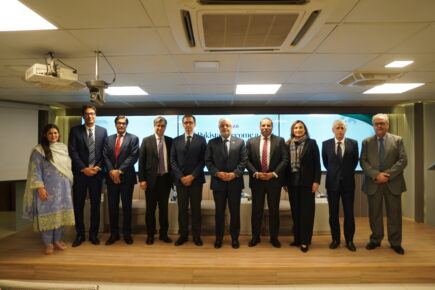
The panel brought together senior jurists, advocates and arbitration specialists, including Justice Jawad Hassan of the Lahore High Court’s Rawalpindi Bench, former Advocate General Punjab Asma Hamid, Barrister Salahuddin Ahmed, Feisal Naqvi, Ahmer Bilal Soofi, and Brig (retd) Raja Shozab Majeed and Barrister Mian Sheraz Javed of the Chartered Institute of Arbitrators (CIArb) Pakistan.
A Consumer, Not a Provider
The discussion started from an uncomfortable fact. Pakistan’s trade and investment have grown, particularly through the China-Pakistan Economic Corridor (CPEC), but most commercial disputes involving Pakistani parties are still resolved in London, Singapore or Dubai. That makes Pakistan a buyer of arbitration services rather than a seller, and the bill is steep. Speakers estimated that a single international arbitration typically costs the parties at least two to three million pounds or dollars, before the time lost and the damage to commercial confidence.
The IPRI President pointed to Pakistan’s recent role as a diplomatic mediator, including hosting talks between the United States and Iran in Islamabad, as evidence of credibility that could carry over into commercial dispute resolution.
Justice Jawad Hassan: Cost and Goodwill Are on Pakistan’s Side
Justice Jawad Hassan argued that Pakistan is well placed to become a preferred seat because of its cost advantages and current geopolitical goodwill. He said the country is making steady progress on arbitration and mediation infrastructure and laws, driven by strong demand for commercial dispute resolution. He also said the pending judgment in the Star Hydro case would pave the way for further progress, which makes it a decision for practitioners to watch.
The Foundations Already in Place
The panel identified several building blocks Pakistan already has:
- Enforceability: Pakistan is a party to the New York Convention, so awards made in Pakistan can in principle be enforced across the world. Pakistani courts have also shown a clear pro-enforcement approach to foreign arbitral awards.
- Growing jurisprudence: The domestic framework still rests largely on the Arbitration Act 1940. However, arbitration case law has grown rapidly. Two years ago there were about 56 reported judgments; that figure now stands at around 120, with roughly 60 delivered in the last two years alone.
- Mandatory mediation: Pakistan is one of only seven countries in the world with a mandatory mediation regime. Speakers credited mediation with major public savings, including settlements worth more than Rs1 trillion with independent power producers and a recent $6.6 billion refinery upgrade deal.
- A growing bench of arbitrators: Two years ago, Pakistan had only six to eight CIArb fellows. It now has close to 100. By comparison, speakers cited about 150 in Singapore, 42 in India and 39 in the UAE.
The Reform Pipeline
Three pieces of legislation are said to be in the works:
- A law to implement the Singapore Convention on Mediation;
- A new arbitration bill based on the UNCITRAL Model Law, which would finally replace the 1940 framework; and
- Commercial courts legislation aimed at faster resolution of business and investment disputes.
Panellists stressed that passing these laws would not be enough. How they are implemented will determine whether international users take Pakistan seriously.
A Warning from Abroad
The most sobering part of the discussion was the comparative evidence. Arbitration centres set up in Kenya (2013), Rwanda (2008) and Egypt (1978) have remained almost entirely domestic. In Egypt, even after several decades, only around 10 percent of arbitrator appointments go to non-Egyptians.
A 2025 survey of African practitioners reinforced the point. About 60 percent chose London as their preferred seat and 18 percent chose Singapore, while none chose an African seat. When asked what makes a seat attractive, over 56 percent cited a strong enforcement record and 54 percent cited neutrality and impartiality.
The lesson is simple: a reputation as a seat has to be earned. New legislation and new buildings do not win the trust of parties choosing where to arbitrate.
A Decade-Long Undertaking
The seminar concluded that Pakistan can realistically become a seat of international arbitration and mediation. Its lower costs, growing pool of arbitrators, expanding commercial activity and current diplomatic goodwill all work in its favour. However, the panel was clear that getting there will require coordinated effort from the legislature, the judiciary and the profession over roughly the next ten years.
