
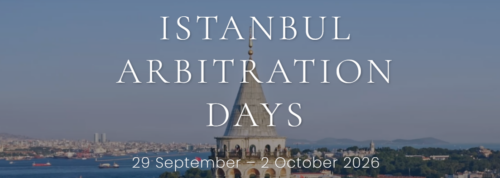
ISTANBUL: Istanbul Arbitration Days 2026 brought together leading international arbitration practitioners, arbitrators, institutional representatives, in-house counsel and experts from across the world for several days of discussions on some of the most consequential developments affecting international dispute resolution.
Held in Istanbul from 29 September to 2 October, with related events beginning on 28 September, the third edition of Istanbul Arbitration Days reflected the city’s increasingly important position as a meeting point between Europe, Asia, the Middle East and other emerging arbitration markets.
The programme covered a wide range of issues shaping the future of international arbitration, including geopolitical fragmentation and sanctions, artificial intelligence, investment treaty arbitration, enforcement, energy and construction disputes, third-party funding, parallel proceedings, procedural efficiency and the increasing importance of regional arbitral centres.
Arbitration in a Changing Geopolitical Environment
One of the strongest themes emerging from this year’s discussions was the impact of geopolitical change on international disputes.
A major session titled “A World Redrawn: How Geopolitical Realignment is Reshaping Disputes and What Clients Now Need From Counsel” was moderated by leading international lawyer Professor Khawar Qureshi KC and included Caroline Croft of Enyo Law, Heiko Heppner of Bird & Bird, Wolfgang Peter of Peter & Kim and Evgeniya Neverova of Asari Legal.
The discussion examined how sanctions, political realignment and increasingly fragmented regulatory regimes are influencing decisions concerning arbitral seats, institutions, counsel, experts, enforcement strategies and the location of recoverable assets.
The wider discussions at Istanbul also reflected an increasingly important reality for international disputes practitioners: obtaining a favourable award is only part of the equation. Counsel must increasingly consider enforcement, asset recovery, sanctions exposure and competing legal regimes from the earliest stages of a dispute.
States, Commercial Arbitration and Investment Treaty Claims
Another significant discussion examined the increasingly complex relationship between commercial arbitration and investment treaty proceedings involving states.
Hafsa Zayyan, partner at Quinn Emanuel Urquhart & Sullivan in London, moderated the panel “Same Defendant, Different Game: Commercial Arbitration and Investment Treaty Claims Against the State.”
The panel brought together Marisa Planells Valero of the International Centre for Settlement of Investment Disputes (ICSID), Associate Professor Eda Manav Özdemir, Dr Mehmet Karlı and Ece Akıncıbay.
The subject is particularly significant for governments, investors and international counsel operating across emerging markets, where the same underlying investment or project may potentially generate contractual claims, treaty claims and proceedings across multiple forums.
Zayyan, who is also an author, has an international practice spanning arbitration, cross-border litigation, investment treaty disputes and public international law.
Energy Security and International Disputes
Energy and natural resources were another major component of the programme.
At the ArbitralWomen Breakfast on 1 October, leading barrister and international arbitrator Mahnaz Malik joined Professor Kamalia Mehtiyeva, Esen İrtem Karagöz, Karl Pörnbacher and Associate Professor Eda Manav Özdemir for a discussion titled “From Energy Security to Energy Disputes.”
The discussion was particularly timely as geopolitical pressures, energy-transition policies and changing patterns of investment continue to create new categories of commercial and investment disputes.
The broader Istanbul Arbitration Days programme similarly examined energy arbitration, major projects and construction disputes, areas which remain central to international arbitration across Türkiye, the Gulf, Central Asia and other emerging markets.
AI, Technology and the Future of Arbitration
Artificial intelligence also featured prominently in discussions about the future of dispute resolution.
Participants considered both the potential for AI to improve efficiency and reduce the cost and duration of proceedings and the professional risks associated with excessive reliance on emerging technologies.
Those discussions included questions surrounding inaccurate or fabricated AI-generated legal authorities, confidentiality, due process and the continuing responsibility of lawyers and arbitrators to exercise independent professional judgment.
The debate reflected a broader transformation taking place across the legal profession: technology is increasingly becoming part of the infrastructure through which disputes are managed, but human judgment and professional responsibility remain fundamental to the legitimacy of arbitration.
Efficiency, Funding and Enforcement
The conference also addressed longstanding concerns over the cost and duration of international arbitration.
Professor Ziya Akıncı, President of the Istanbul Arbitration Centre (ISTAC), highlighted the institution’s growing caseload and international reach. Discussions involving Professor Ercüment Erdem and other practitioners considered the movement towards stronger case management, expedited procedures and less procedural formalism.
Third-party funding and the ownership of claims also received attention, including their potential implications for investment disputes and enforcement.
These discussions formed part of a wider emphasis at Istanbul Arbitration Days on approaching arbitration strategically from the beginning of a dispute considering not only how a case can be won, but how an eventual award can be enforced and value ultimately recovered.
Pakistani-Origin Arbitration Practitioners at Istanbul
The 2026 gathering also saw a notable presence of international arbitration practitioners of Pakistani origin.
They included Professor Khawar Qureshi KC, who moderated a principal geopolitical session; Mahnaz Malik, an internationally recognised barrister and arbitrator who spoke on energy disputes; and Hafsa Zayyan, partner at Quinn Emanuel, who moderated the discussion on commercial and treaty claims against states.
Prominent participants of Pakistani origin also included Barrister Taimur Malik, founder of Courting The Law and a leading practitioner who has represented clients on arbitration matters across the world for more than two decades now and was previously a partner of international arbitration powerhouse Curtis, Mallet-Prevost, Colt & Mosle LLP and then Clyde & Co, and Syed Ali Naveed, a Middle East-based partner at MAR Law who has advised on and handled arbitration matters across the Gulf, Pakistan and the wider region.
Commenting on the significance of the gathering, Taimur Malik said: “Forums such as Istanbul Arbitration Days are important because they bring together practitioners from established and emerging arbitration markets. For Pakistan, greater engagement with these networks can help develop expertise, encourage cross-border collaboration and ensure that Pakistani lawyers, businesses and institutions are better positioned to navigate international disputes.”
Their presence reflected the increasingly international footprint of Pakistani-origin lawyers practising across London, the Middle East and other major dispute-resolution centres.
For Pakistan, this international engagement is particularly relevant. Pakistani companies, state entities and investors are increasingly exposed to disputes involving infrastructure, energy, foreign investment, cross-border commerce and major projects. Greater interaction between Pakistan’s legal community and international arbitration networks can therefore contribute both to professional capacity and to Pakistan’s participation in the evolving international dispute-resolution architecture.
Istanbul’s Growing Arbitration Role
A broader message emerging from Istanbul Arbitration Days 2026 was the continuing diversification of the international arbitration landscape.
London, Paris, Geneva, Singapore and other established centres remain deeply important, but Istanbul, Dubai, Riyadh and other regional centres are becoming increasingly relevant to disputes arising from rapidly growing commercial corridors.
Türkiye’s location between Europe, the Middle East, Central Asia and the wider Asian region gives Istanbul particular strategic significance.
The range of practitioners and institutions represented at Istanbul Arbitration Days and the breadth of discussions extending from geopolitics and investment treaties to AI, energy, enforcement and sanctions demonstrated how international arbitration itself is evolving in response to a more complex global economic and political environment.
For Pakistan and Pakistani-origin practitioners working internationally, deeper participation in such forums provides an opportunity not merely to observe these developments, but increasingly to contribute to the conversations shaping the future of international dispute resolution.
This report has been prepared by Team CTL based on the Istanbul Arbitration Days 2026 programme and publicly available information.
