
As somebody who advises founders and startups but has never gone through the process of raising investment, I consider fundraising as a new startup the most exciting time for a founder. You are at the precipice of building something, you are actively pitching to investors and anyone who will listen and then finally someone says yes. That first cheque lands. You sign your first SAFE.
Then another.
Then another.
Each new investor comes in at a higher valuation cap because your startup is gaining traction. You feel like you are winning. And in many ways, you are.
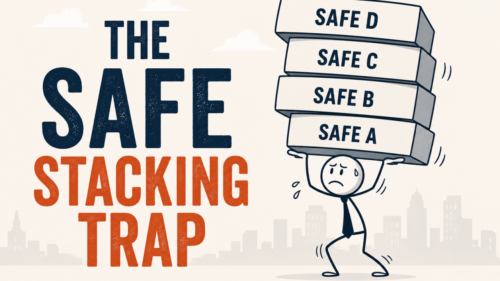
But here is what most founders do not realize until it is too late. Under the standard YC post-money SAFE, every new SAFE locks in a fixed ownership promise. And those promises stack. Not in a “SAFE holders diluting each other” way that was true with pre-money SAFEs. Since 2018, YC made post-money SAFEs the standard. Now, the dilution burden falls squarely on you, the founder.
Let me show you how this plays out.
The simple math that tricks you
With a post-money SAFE, the investor’s future ownership is basically negotiated the day they sign. Here’s the formula:
Ownership % = Investment Amount ÷ Post-Money Valuation Cap
So:
- $250,000 at a $5 Million cap means 5% of the company
- $500,000 at a $10 Million cap means 5% of the company
- $1,000,000 at a $20 Million cap means 5% of the company
- $1,500,000 at a $30 Million cap means 5% of the company
Seems harmless, right? You raised $3.25 million at progressively better valuations in the span of one year. But look at what you’ve given away:
- Founder: 80%
- SAFE holders combined: 20%
That’s before your priced round. Before the employee option pool has been set up. Before any pro rata rights or more bridge rounds.
You have already sold 20% of your company, and you have not even done a priced round yet.
Why different caps make this worse
Different caps aren’t wrong. Early investors deserve better prices, after all they took the risk and believed in you. But stacking SAFEs at higher and higher caps creates three painful dynamics:
1. You lose visibility into real dilution
You’re mentally tracking cash raised, valuation, runway. But the only question that matters is: What percentage of my future company have I already promised away? Post-money SAFEs make that surprisingly hard to see. Each new SAFE feels “cheaper”, but it still carves out a meaningful chunk.
2. SAFE holders are protected. You are not.
This is the hidden feature of post-money SAFEs. Earlier investors don’t get diluted by later ones. Instead, every new SAFE dilutes you, your employees, and future common shareholders. That “small top-up” round? It permanently reduces your stake.
3. The priced round exposes everything
While you’re operating on SAFEs alone, the cap table looks fine. Then, a lead investor builds the fully diluted cap table. That’s when you discover how much you’ve already sold, how much the option pool needs to be refreshed, and how little room is left for future hires. Founders who thought they owned “most of the company” suddenly realize they’re edging toward minority ownership.
I call this the ‘post-money illusion’. You see a higher valuation cap and assume dilution is getting milder. But higher caps don’t erase prior ownership promises. They just stack on top.
The result? Surprisingly aggressive cumulative dilution, even when every individual SAFE looked reasonable.
Most founders don’t over-dilute on purpose. They just:
- Don’t model it out carefully;
- Use overly simple cap tables;
- Misunderstand how post-money SAFEs work; or
- Assume a higher future valuation will fix everything (it won’t).
Lately, I keep catching myself saying the same thing to founders:
“Live to fight another day. Or live at all.”
I know what’s running through your head when you’re in the middle of it. Payroll’s coming. The product needs more time. The team is looking at you. So you take the next SAFE. Then the next. Higher cap, better terms, feels like progress.
And look, keeping the company alive matters. Survival is not stupid. It’s not greedy. It’s the job.
But here’s what I’ve watched other founders learn even harder:
The trade-offs are real, and yours alone to own.
Post-money SAFEs are a fantastic fundraising mechanism when used carefully. But let’s call them what they are: deferred equity. Every single one changes your eventual ownership structure.
Too many startups stay in “SAFE mode” way too long. I’ve seen it. You’ve probably seen it. Repeated bridge SAFEs, each one reasonable on its own, quietly erode founder ownership before a priced round ever happens. No malice. No bad actors. Just major dilution by a thousand reasonable decisions.
So here’s my advice:
Model your dilution after every single SAFE. Not once a quarter. Not before the priced round. Every time.
Raise only as much as you ACTUALLY NEED. Not what’s available. Not what feels good. Only NEED.
And build your option pool from day one. Don’t back into it later. Start with it. Treat it like rent. It’s not a future problem, it’s a now cost.
Because at the end of the day, you have to live to fight another day and ensure that you keep living in the future.
Disclaimer: This post is for educational purposes only and does not constitute legal or investment advice.
