
7th July 2026
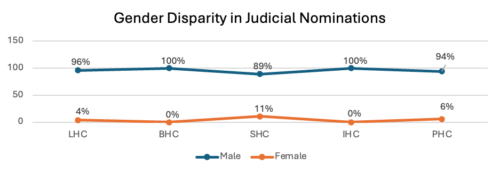
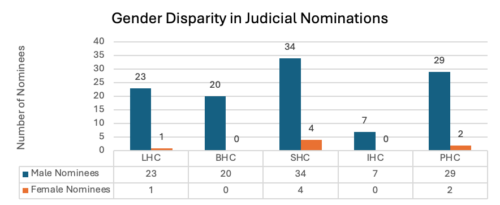
The stark gender disparity in the recent lists of nominees for judicial appointments to Pakistan’s provincial high courts, currently under consideration by the Judicial Commission of Pakistan (JCP) for its meetings scheduled between 20–24 July 2026, is deeply troubling. It also raises serious constitutional concerns.
This pattern sits uneasily with Article 25(3), read together with Article 34 of the Constitution of Pakistan 1973. These provisions recognise that formal equality alone is insufficient and require the State to adopt affirmative measures to ensure the full participation of women in all spheres of national life. Judicial appointments are no exception.
Before the 26th and 27th Constitutional Amendments and prior to the amendment of the JCP Rules in 2024, the names of candidates for judicial appointment were forwarded to the Judicial Commission by the Chief Justice of the respective High Court. Rule 9 of the Judicial Commission of Pakistan Rules, as amended in 2024 has since significantly broadened the nomination process. Today, any member of the Judicial Commission, including representatives of the executive and the legal profession can initiate nominations for consideration.
The expectation was that widening the power to nominate would diversify the pool of candidates and make the process more inclusive. Yet, despite this structural change, the outcome for women has remained virtually unchanged. In Islamabad and Balochistan not a single female candidate has been nominated for consideration. In Lahore, only 1 female and 23 men while in Sindh 4 females and 34 men have been included. These figures are neither diverse nor fair and certainly not equal but Sindh remains the leading province for now for having 11% nominations comprising of women in its list.
Interestingly, in Sindh the 38 nominees will compete against 5 vacancies while in Punjab, the 24 nominees will compete against 10 vacancies.
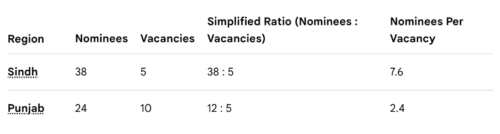
Therefore, Sindh features a significantly more competitive landscape, with more than three times the number of candidates vying for each available slot compared to Punjab. In this scenario, even though the number of female nominees is higher in Sindh but the number of vacancies is half that of Punjab.
In Peshawar, the appointments of Additional Judges were made earlier in the year 2025. 31 candidates were nominated against 10 vacancies in December 2024.[1] Of these 31, only 2 were women. Thereafter, in a meeting dated 1st February 2025, the JCP appointed 10 Additional Judges for the Peshawar High Court out of the the 31 nominees and out of the 2 female nominees, one was appointed.[2] In January 2026, 6 of those 10 Additional Judges were confirmed while the remaining 4, including the one female judge were given extension for a period of six months.[3] At the upcoming meetings of the JCP in July 2026, the members will consider confirmation of these four Additional Judges for Peshawar High Court.[4]
The overwhelming majority of members of the Judicial Commission seem to continue to replicate longstanding patterns of exclusion by overwhelmingly nominating men and giving little meaningful consideration to the inclusion of women. This is particularly disappointing given that Rule 6 of the Judicial Commission of Pakistan Rules, 2024 expressly recognises diversity as a guiding principle in the appointments process and expressly covers gender diversity.
The JCP is composed almost exclusively of all men save for Justice Aalia Neelum who is a member of JCP for Punjab because she is the Chief Justice of the Lahore High Court. This means altogether out of 35 members of the JCP only 1 is a female. This is also a matter of concern for us.
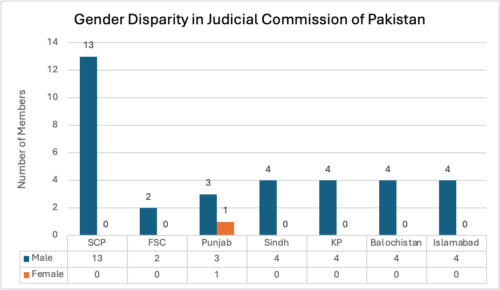
Source: https://www.supremecourt.gov.pk/downloads_judgements/all_downloads/judicial_commission/Ld_Members_of_Judicial_Commission_of_Pakistan.pdf
When women are not nominated, they are denied even the opportunity to be assessed on merit alongside their male counterparts. Exclusion at the nomination stage functions as a powerful form of institutional gatekeeping. It narrows the pipeline before any evaluation of suitability can even take place and ensures that the status quo remains intact.
Meaningful representation on the bench cannot be achieved if women are systematically excluded from the pool of candidates under consideration. A fair appointments process requires a fair nominations process. Until there is fair and adequate representation of women in nominations, there cannot be fair representation in appointments.
Every member of the Judicial Commission must actively identify, encourage and nominate female candidates so that the pool of nominees genuinely reflects the gender diversity of Pakistan’s legal profession. Accordingly, we call upon the Judicial Commission of Pakistan to withdraw the current nomination lists and issue revised lists that ensure the fair and adequate nomination of female candidates across all provincial high courts. This is a demand for an equal opportunity to be considered. Women cannot be appointed at all if they are excluded from the nomination process.
We further urge the Judicial Commission to develop and adopt a comprehensive policy for mainstreaming women in judicial appointments in consultation and collaboration with diverse female lawyers and judges because women are not a monolith and it is important to include women across the spectrum of intersectionality for making any policy. Such a policy should address the entire appointments pipeline from identifying, encouraging and training eligible female candidates, to ensuring gender-inclusive nomination practices, monitoring and publishing gender-disaggregated data and embedding diversity as a measurable consideration throughout the appointments process. This would give practical effect to Rule 6 of the Judicial Commission of Pakistan Rules, 2024 and to the constitutional commitment embodied in Articles 25(3) and 34. Transparency and accountability are essential if diversity is to be more than an aspirational principle.
Women lawyers, judges and legal academics across Pakistan have demonstrated, time and again, that the talent and experience exist. The problem is not a lack of qualified women; it is a lack of equal access to opportunity. The Judicial Commission must therefore, move beyond acknowledging diversity as a principle and begin treating it as a constitutional obligation. Only then can Pakistan move towards a judiciary that truly reflects the society it serves.
[1] Waseem Ahmad Shah, ‘31 candidates nominated for appointment as Peshawar High Court judges’, Dawn, 16 December 2024. Available at: https://www.dawn.com/news/1878975.
[2] Press Release, ‘Meeting of the Judicial Commission of Pakistan’, 1 February 2025. Available at: https://www.supremecourt.gov.pk/meeting-of-judicial-commission-of-pakistan-01-feb-2025/.
[3] Press Release, ‘Judicial Commission of Pakistan Makes Recommendations for Confirmation of Additional Judges of the Peshawar High Court,’
14 January 2026. Available at: https://www.supremecourt.gov.pk/judicial-commission-of-pakistan-makes-recommendations-for-confirmation-of-additional-judges-of-the-peshawar-high-court-14-jan-2026/.
[4] Nasir Iqbal, ‘JCP likely to Meet on 20th To Confirm Additional Judges’, Dawn, 7 July 2026. Available at: https://www.dawn.com/news/2013488/jcp-likely-to-meet-on-20th-to-confirm-additional-judges
