Introduction
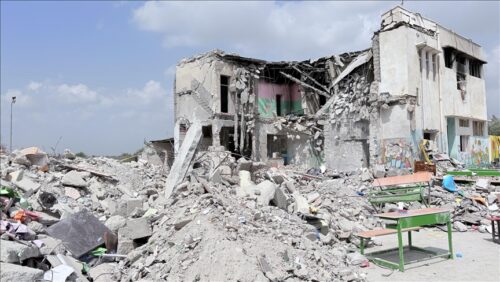
On the 28th of February 2026, the US and Israel attacked Iran, killing the head of state, Iran’s Supreme Leader Ayatollah Ali Khamenei. The armed attack was carried out under the premise of preventing Iran from acquiring a nuclear weapon through regime change. During the armed conflict, the US-Israel targeted civilians and civilian objects, including schools, residential buildings, hospitals and medical facilities, bridges and a major stadium, and threatened to target and destroy the electricity infrastructure in Iran and to send them back to stone age.
This article will evaluate the legality of US-Israel’s use of force under the legal framework governing jus ad bellum (resort to force) and the conduct of hostilities during armed conflict in Iran under the legal framework governing jus in bello (conduct of hostilities).
Illegal use of force
Under Article 2 (4) of the United Nations (UN) Charter, any use or threat of use of force against the territorial integrity and political independence of a State is prohibited. The absolute prohibition on ‘use of force’ was recognized as customary international law by the International Court of Justice (ICJ) in theMilitary and Paramilitary Activities in and against Nicaragua (Nicaragua v. United States of America) Case. ICJ in Nicaragua deduced opinio juris from, among others, the General Assembly’s Resolution 2625 (XXV) titled “Declaration on Principles of International Law concerning Friendly Relations and Co-operation among States in accordance with the Charter of the United Nations” as to the customary nature of prohibition on the use of force. Resolution 2625 reiterates every State’s duty to refrain from the “threat or use of force to violate existing boundaries of another State or as a means of solving international disputes…” It also stipulates that “States have a duty to refrain from acts of reprisal involving the use of force.”
The only exceptions to Article 2 (4) are the inherent right to self-defence under Article 51 and Chapter VII of the UN Charter. Under Article 51, States have the inherent right to individual or collective self-defence if an “armed attack” occurs. Under Chapter VII, the UN Security Council may authorize use of force in response to “any threat to the peace, breach of the peace, or an act of aggression”.
Furthermore, Iran did not attack Israel and the US; and the Security Council did not authorise an attack on Iran. It has been well documented that there was no evidence of an imminent Iranian attack. However, the decision to attack Iran appears to be based on “preventive self-defence”, i.e. preventing Iran from acquiring nuclear capabilities in the future, which is neither recognised under the UN Charter nor customary international law. The ICJ in Armed Activities on the Territory of the Congo (Democratic Republic of the Congo v. Uganda) judgment clarified that Article 51 “…may justify the use of force in self-defence only within the strict confines there laid down. It does not allow the use of force by a State to protect perceived security interests beyond those parameters”, thereby ruling out ‘preventive’ as well as ‘pre-emptory’ self-defence’[1].
Furthermore, the US-Israel attack on Iran may also be termed as an act of aggression. Aggression was defined under the UN General Assembly Resolution 3314 (XXIX). Article 1 defines aggression as “the use of armed force by a State against the sovereignty, territorial integrity or political independence of another State, or in any other manner inconsistent with the Charter of the United Nations, as set out in this Definition.” Aggression includes, among others, “invasion or attack by the armed force of a State of the territory of another”, “bombardment by the armed forces of a State against the territory of another State”, and “attack by the armed forces of a State on the land, sea, or air force, or marine and air fleets of another State”. No consideration of any change, whether of political, economic, military or otherwise, may serve as a justification for aggression (Article 5 (1)). War of aggression is deemed a crime against international peace and gives rise to international responsibility (Article 5 (2)). Additionally, no territorial acquisition or special advantage arising from aggression is or shall be recognized as lawful (Article 5 (3)).
The Nuremberg International Military Tribunal proclaimed that “To initiate a war of aggression…is not only an international crime; it is the supreme international crime differing only from other war crimes in that it contains within itself the accumulated evil of the whole.” This was in pursuance of Article 6 (a) of the Charter of the Nuremberg International Military Tribunal where “planning, preparation, initiation or waging of a war of aggression” were defined as crimes against peace. The Nuremberg judgment was followed by the International Tribunal for the Far East, Tokyo. Thereby establishing individual criminal responsibility for “war of aggression”. It is clear from World War II case law that individual liability for crimes against peace can only be incurred by high-ranking persons such as leaders and policymakers, whether they are military or civilian.
Moreover, any threat or use of force by a State that goes beyond the framework defined in the UN Charter would lead to international state responsibility. Arguably, it may amount to an act of aggression. However, any question concerning individual criminal responsibility is subject to the question of jurisdiction of the International Criminal Court.
International Humanitarian Law
The ‘principle of distinction’ is a cardinal principle of International Humanitarian Law, which stipulates that parties to an armed conflict must at all times distinguish between the civilian population and combatants, and between civilian objects and military objects. An armed attack is further regulated by principles of ‘proportionality’ and ‘precaution’. The principle of proportionality prohibits armed attacks which would be excessive in relation to the “concrete and direct military advantage anticipated” (Article 51(5)(b) of Additional Protocol I of the 1949 Geneva Conventions). Moreover, ‘precautions’ in attack are required to avoid or minimise loss of civilian life, injury to civilians, and damage to civilian objects (Ibid, Article 57).
Furthermore, under Article 51 of Additional Protocol I (AP I), the civilian population and individual civilians enjoy general protection from dangers arising from military operations. The civilian population as such, as well as individual civilians, shall not be object of attack. Similarly, under Article 52, civilian objects shall not be the object of attack or reprisals, and attacks shall be strictly limited to military objectives. Moreover, Article 54 (2) provides for “Protection of objects indispensable to the survival of the civilian population”. It is prohibited to starve civilians as a “method of warfare”, and to “attack, destroy, remove or render useless objects indispensable to the survival of the civilian populations” with the intent or “specific purpose” of denying the civilian population of their sustenance value. It lays out examples “such as” foodstuffs, crops, livestock, drinking water installations and supplies and irrigation works”. However, the word “such as” indicates that this is not an exhaustive list. It may involve deprivation or insufficient supply of any essential commodity, which is necessary for survival of civilian population, e.g., hospitals and medical facilities, supply of electricity, civilian infrastructure such as bridges, etc.[2] This prohibition shall not apply if the objects covered under paragraph 2 are used by an adverse Party: as sustenance solely for the members of its armed forces; or in direct support of military action (Article 54 (3)). However, it is clarified that “in no event shall actions against these objects be taken which may be expected to leave the civilian population with such inadequate food or water as to cause its starvation or force its movement” (Ibid).
The US-Israel initiated armed attacks on Iran on 28th February 2026, and proceeded to target both civilian and military objects. Reportedly, killing more than 3000 people, including children. The attacks targeted multiple civilian objects, including hospitals, medical facilities, bridges, schools, universities and historical sites in Iran. On 28th February, the Shajareh Tayyebeh Primary School in Minab, Iran, was struck, resulting deaths of at least 175 people. Reportedly, more than 125,000 residential and civilian buildings have been damaged. By an estimate, the indiscriminate attacks and destruction have placed the livelihood of nearly half of the Iranian workforce at risk.
Moreover, the White House repeatedly threatened to send Iranians back to the stone age, presumably, by attacking and destroying the electricity infrastructure and bridges. Significantly, before the ceasefire, Donald Trump threatened that the entire “civilisation” would die. While Israeli Defence Minister Katz, in late April, stated that, in addition to “returning Iran to the dark and stone ages”, this time the attack will be “deadlier and will add devastating blows in places that hurt most”. All such acts, when committed purposefully, amount to grievous violations of international humanitarian law and war crimes.
The illegal threats to Iranian civilization and scale of destruction to civilian life and objects suggest that attacks were carried out indiscriminately, without considering principles of distinction, proportionality and precaution.
Conclusion
Article 2 (4) of the UN Charter imposes an absolute prohibition on use of force, subject to narrowly defined exceptions under Article 51 and Chapter VII. The same has been reinforced by the jurisprudence of the ICJ, which reflects the customary international law. The recent attack on Iran appears to be based on preventing Iran from attaining nuclear weapons, i.e. preventive self-defence. Such justification is unfounded in the established legal framework governing use of force under international law.
Moreover, the scale of civilian casualties and destruction of objects indispensable to civilian survival raises serious concerns under the principles of distinction, proportionality, and precaution. These actions are not merely unlawful, but constitute grave violations of international law, engaging both state responsibility and international criminal responsibility (subject to the question of jurisdiction).
[1] Gleider Hernández, International Law (Oxford University Press 2019), p.359.

