Pakistan has never lacked sporting talent. From Olympic medalists and squash champions to internationally recognized cricketers and mountaineers, the country’s athletes have repeatedly demonstrated that excellence […]
A SWORD OR A SHIELD? THE LEGAL CONTOURS OF THE DOCTRINE OF PAST AND CLOSED TRANSACTIONS IN THE REALM OF PAKISTANI JURISPRUDENCE
“It is established law that the legislature has the plenary power to enact laws with retrospective and prospective effect subject to such laws not effecting past […]
Mediation as an Alternative Dispute Resolution Mechanism in Pakistan
Pakistan is facing a significant judicial crisis due to the enormous backlog of cases pending in its courts. Currently, there are approximately 2.3 million cases awaiting […]
The Pakistan Virtual Assets Act 2025 and the Balance Between Regulation and Innovation: A Critical Legal Analysis
For nearly a decade, Pakistan’s legal position on cryptocurrencies and digital assets was marked by ambiguity. Traders, investors, and exchanges operated in a legal vacuum. The Virtual […]
When the constitution falters
There are times when a nation faces a constitutional crisis. Unfortunately, this term has become a synonym for any situation involving conflict, so much so that […]
Regulating Artificial Intelligence: Can the Law Keep Up with Innovation?
Artificial Intelligence (AI) has emerged as a transformative technology influencing key sectors such as healthcare, finance, law enforcement, and armed conflict. It is broadly defined as […]
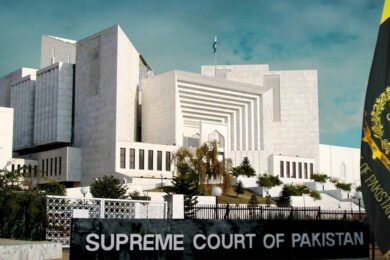
Arshad alias Billu v The State: No Discrimination on the Bais of Muslim and New Muslim SC Judgment
In Arshad alias Billu v. State, the Supreme Court of Pakistan directed all Inspectors General of Police to ensure that no derogatory or discriminatory terms are […]
The IHL and Protection of Cultural Heritage
Cultural heritage enjoys a special status and protection under International Humanitarian Law (IHL). It is recognized not merely as civilian property, but as part of the […]
Offloading of Airline Passengers in Pakistan: Constitutional Limits, Statutory Authority, and Emerging Judicial Standards
The practice of offloading airline passengers at Pakistani airports ignites a debate all around the country and people have started questioning its legality. Although it is […]
Fakhar Majeed v. Government of Punjab: A Critical Analysis of Timely Consideration and Constitutional Service Law
The Honourable Ms. Justice Ayesha A. Malik has held that delays caused by the employer cannot be used as an excuse to deny or delay an […]
Revisiting District Bar Association v The Federation of Pakistan
The only aftermath of Twenty-Seventh constitutional amendment happens to be the re-emergence of the debate surrounding the scope of parliament’s amending power. This renewed relevance necessitates […]
Allocating Climate Burdens Fairly: The Role of CBDR in International Law
In its recent advisory opinion on States’ obligations in relation to climate change, the ICJ addressed several important dimensions of international environmental law. Most notably, it […]
Construction Works: Services or Goods?
After the 18th Amendment[1] to the Constitution[2], goods are taxed by the federal legislature, and the services by the provinces[3]. There is no concurrency in tax. For a particular transaction, the tax is either levied by the federal legislature, or by the provinces. Under the current framework, the supply of goods is taxed by the center under the Sales Tax Act, 1990. The provinces, after the 18th Amendment, have promulgated provincial legislations to bring the taxation on services within their provincial domain.
Book Review: The Competition Commission of South Asia: Policy Diffusion and Transfer by Dr. Amber Darr
The Competition Law in South Asia: A Policy of Diffusion and Transfer is the first book of its kind in Pakistan on this subject. It is […]

The Precautionary Principle in International Environmental Law
The precautionary principle is often underemphasized in discussions of international environmental law, but this principle is important as it shifts the burden of proof to those […]
Continuing Professional Development for the Legal Community
Continuing Professional Development (CPD) is a vital component of professional life worldwide. In almost every profession, such as medicine, engineering, accounting, teaching, and public administration, professionals […]
Supreme Court Upholds Wedlock Policy: A Landmark Ruling on Family Protection in Pakistan’s Civil Service
The case Mubashir Iqbal Zafar v. Ministry of Defence, through its secretary, was recently decided by the Honorable Ms. Justice Ayesha A. Malik regarding the implementation […]